 English
 Magyar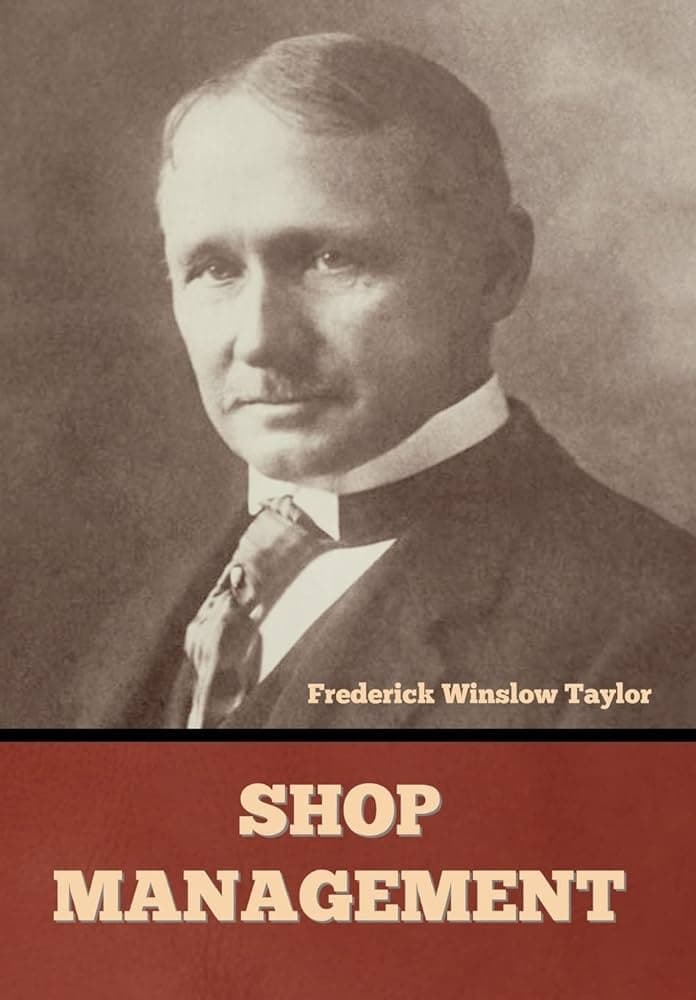
Shop Management
Frederick Winslow Taylor
Free download · 500+ book summaries
What is Shop Management about?
In his book The Lord of Easy Money, journalist Christopher Leonard analyzes the decisions and policies of one of the most mysterious American institutions, the Federal Reserve. Leonard explains how the Fed guided the U.S. economic system before, during, and after the 2008 financial collapse, and sheds light on its authority to regulate interest rates, as well as its ability to encourage banks and investors to take on riskier debt.
Read an excerpt from the summary
The Stopwatch That Changed Work
Frederick Winslow Taylor walked into the yard at Bethlehem Steel in 1898 and found four hundred laborers loading pig iron onto railroad cars at the same dull pace their fathers had loaded it. The going rate was a dollar and fifteen cents a day. The going output was twelve and a half tons per man. Nobody questioned either number, because nobody had ever measured what one well-fed, well-instructed worker could actually do with a ninety-two-pound piece of iron and a level path to a freight car. Taylor measured it. The answer, once he had timed every motion with a stop watch and rebuilt the work around the result, was forty-seven tons.
That single difference — between twelve and forty-seven — is the entire argument of *Shop Management*, the 1903 paper Taylor wrote for the American Society of Mechanical Engineers. He didn't believe American factories were lazy. He believed they were running on guesswork. Managers guessed at how long jobs should take. Workers guessed at how hard their bosses expected them to push. Both sides bluffed and bargained over numbers neither could defend, and the resulting drift cost everyone money. Taylor's claim was that the work of running a shop could be treated as a body of measurable knowledge — that there was, for any task, a best way of doing it, and that the best way could be found, written down, taught, and rewarded.
He was not subtle about what this required. It required, he said, a complete revolution in the mental attitude of everyone involved, from the directors down to the helper who swept the floor. It required spending money on planning rooms and time clerks and inspectors before any of that spending paid off. It required years of patient implementation, and the loss of trusted old foremen who could not adapt. And it required dropping the comfortable fiction that managing people was a knack you either had or didn't. Taylor said it was an art, but an art built on data. The rest of the book is the proof.
Like it?
Continue in the appRead it in 52 minutes
The summary of Shop Management and 500+ more books await in the BookBase app.