 English
 Magyar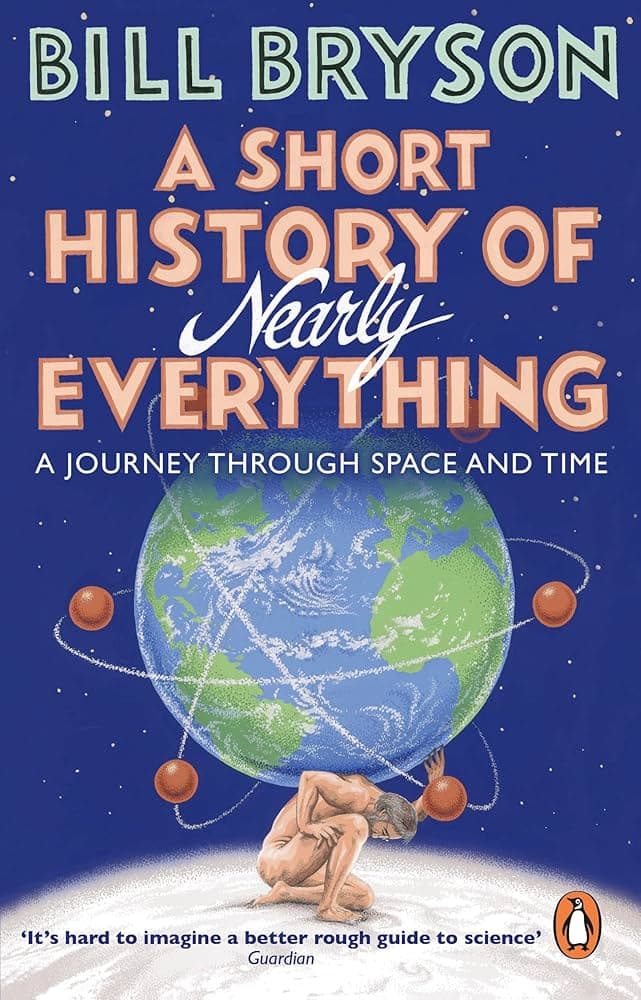
The Short History of Nearly Everything
Bill Bryson
Free download · 500+ book summaries
What is The Short History of Nearly Everything about?
A Short History Of Nearly Everything (Majdnem minden rövid története) explains everything we’ve learned so far about our world and the universe, including how they were formed, how we learned to interpret time, space, and gravity, why it's such a miracle that we are alive, and how much of our planet remains a complete mystery to us.
Read an excerpt from the summary
Pick yourself apart with tweezers. Atom by atom. You'd end up with a small heap of dust, none of it ever alive, all of it once you. That image — bizarre, slightly nauseating, weirdly tender — is where Bill Bryson chooses to start. Not with a great man, not with a planet, not with a famous date. With you, atomized.
The premise that runs underneath the whole book is straightforward and slightly insulting. You are a temporary arrangement of borrowed parts. The arrangement has never existed before and will not exist again. The atoms cooperating to make you have no idea you are here. They will rearrange themselves into a beetle or a tomato or part of a sidewalk the moment you stop paying them. And yet for the roughly six hundred fifty thousand hours of an average life, they hold the formation. That, Bryson wants you to understand, is the actual miracle.
A Short History of Nearly Everything is his attempt to explain how we know any of this. It is not a textbook. It is a tour of how human beings, most of them eccentric and many of them mildly insane, figured out that the universe is thirteen point seven billion years old, that Earth is four and a half billion, that continents drift, that atoms exist, and that you and Shakespeare almost certainly share a billion atoms. Bryson started reading because he didn't know why oceans are salty but the Great Lakes are not. Three years later he had a book.
How to Build a Universe
Start with nothing. Not empty space — nothing. No location, no prior time, no around. Compress everything that will ever exist into a single point that has no size, and then, without warning, let it expand. In the first second the four fundamental forces appear. Within a minute the universe is a million billion miles across, ten billion degrees hot, and busy fusing hydrogen and helium. In three minutes, ninety-eight percent of all the matter there will ever be has been made. That, Bryson notes, is about the time it takes to put together a sandwich.
Like it?
Continue in the appRead it in 51 minutes
The summary of The Short History of Nearly Everything and 500+ more books await in the BookBase app.